Monday, October 24, 2016

Bloggers Take on Bethel United Methodist

Just after a weekend trip to Magnolia Cemetery the day before, the Beyond the Grave FYE class traveled to Bethel United Methodist Church on the corner of Pitt and Calhoun. The small graveyard boasts only 519 internments, however not near that many headstones are in the small cemetery of today. With only one distinguished "guest" inside the fences it is not a very well known graveyard around town (guest found through findagrave.com)

Our main mission was to find 10 or more graveyard symbols and describe them for part of the midterm grade. In the small space there were plenty of symbols to find and I have a few of them here outlined for you. All symbols are identified with either Stories Told in Stone by Gaylord Cooper or a grave symbol website included in the course.


This is a photo of the famous internment at Bethel, a Confederate general named Francis Capers. He was born on August 8, 1819 and died January 11, 1982. He was not only a general but also taught at the old Citadel Military School. He has a simple cross inside a circle which represents Christianity and eternal life.


This second, most likely fallen headstone, belongs to Charles C. Seyle. Born July 12, 1828 and died February 10,1880. This headstone has a cross which again symbolizes Christianity but also ivy vines around it which denote friendship. This makes sense due to many people with the last name Seyle are in this cemetery.


Ms. Catherine L. Lord was born September 27, 1826 and died just a few days shy of her birthday on September 25, 1859. Her headstone leaned up against the buildings side has an elaborate wreath with ribbons woven throughout it. This stone also has the births and deaths of a few other members of her family. The wreath symbolizes victory in death with the ribbons meaning not easily found an does not have a specific meaning.


Anna Elizabeth Chrietzberg was born March 15,1821 and died January 18m 1872. She was the wife of a pastor and has a flying dove and wreath on her die on socket headstone. The wreath symbolizes victory in death and the flying dove  represents the holy spirit and is often used on graves with a Christian background.


William H. Fleming was the pastor at Bethel during the middle 1800s and born January 1, 1821 and died April 16, 1877. He has a cradle grave adorned with a bible on he top and a wreath with what looks to be poppy flowers and roses. The bible obviously denotes that he was a man of God and the wreath meaning the same thing as earlier discussed. The poppy flowers and roses mean eternal sleep and beauty respectively.


Elizabeth M. Ainger was born October 14, 1807 and died October 6, 1872. Her headstone is kind of hidden away by this bush on the side of the building. Her headstone boasts many different types of flowers and a dove with a branch in its mouth. The flowers look to include daisies which means innocence. The dove with a branch in its beak symbolizes peace, hope, and promise.


Anna Eliza Childers was born May 25, 1842 and died May 19, 1859. Her headstone is also leaned up against the building as well. It has wilted rose flower on the top. This is considered wilted and broken by the book which often denotes a teen death as well as mortality.


This headstone is my favorite partly because I love willow trees and it just seems like a hidden beauty of the graveyard. James F. M. Lord was born sometime in 1825 and died on February 1, 1862. His weeping willow symbolizes the sadness and mourning of a family.


Mary Syfan was born December 30, 1775 and died July 26, 1823. She has what looks to be a weeping woman under w willow tree. The weeping woman means mourning and sorrow as does the weeping willow that she is under.


Elizabeth Moore was born sometime in 1796 and died October 26, 1865. She was another pastor's wife and has a beautiful angel on the top of her headstone turned ledger. The angel means  guide to heaven.


Overall, the class visit to Bethel United Methodist was a short walk away from campus and  boasted many different symbols in a very tiny space downtown.


Bloggers Take on Bethel United Methodist

Just after a weekend trip to Magnolia Cemetery the day before, the Beyond the Grave FYE class traveled to Bethel United Methodist Church on the corner of Pitt and Calhoun. The small graveyard boasts only 519 internments, however not near that many headstones are in the small cemetery of today. With only one distinguished "guest" inside the fences it is not a very well known graveyard around town (guest found through findagrave.com)

Our main mission was to find 10 or more graveyard symbols and describe them for part of the midterm grade. In the small space there were plenty of symbols to find and I have a few of them here outlined for you. All symbols are identified with either Stories Told in Stone by Gaylord Cooper or a grave symbol website included in the course.


This is a photo of the famous internment at Bethel, a Confederate general named Francis Capers. He was born on August 8, 1819 and died January 11, 1982. He was not only a general but also taught at the old Citadel Military School. He has a simple cross inside a circle which represents Christianity and eternal life.


This second, most likely fallen headstone, belongs to Charles C. Seyle. Born July 12, 1828 and died February 10,1880. This headstone has a cross which again symbolizes Christianity but also ivy vines around it which denote friendship. This makes sense due to many people with the last name Seyle are in this cemetery.


Ms. Catherine L. Lord was born September 27, 1826 and died just a few days shy of her birthday on September 25, 1859. Her headstone leaned up against the buildings side has an elaborate wreath with ribbons woven throughout it. This stone also has the births and deaths of a few other members of her family. The wreath symbolizes victory in death with the ribbons meaning not easily found an does not have a specific meaning.


Anna Elizabeth Chrietzberg was born March 15,1821 and died January 18m 1872. She was the wife of a pastor and has a flying dove and wreath on her die on socket headstone. The wreath symbolizes victory in death and the flying dove  represents the holy spirit and is often used on graves with a Christian background.


William H. Fleming was the pastor at Bethel during the middle 1800s and born January 1, 1821 and died April 16, 1877. He has a cradle grave adorned with a bible on he top and a wreath with what looks to be poppy flowers and roses. The bible obviously denotes that he was a man of God and the wreath meaning the same thing as earlier discussed. The poppy flowers and roses mean eternal sleep and beauty respectively.


Elizabeth M. Ainger was born October 14, 1807 and died October 6, 1872. Her headstone is kind of hidden away by this bush on the side of the building. Her headstone boasts many different types of flowers and a dove with a branch in its mouth. The flowers look to include daisies which means innocence. The dove with a branch in its beak symbolizes peace, hope, and promise.


Anna Eliza Childers was born May 25, 1842 and died May 19, 1859. Her headstone is also leaned up against the building as well. It has wilted rose flower on the top. This is considered wilted and broken by the book which often denotes a teen death as well as mortality.


This headstone is my favorite partly because I love willow trees and it just seems like a hidden beauty of the graveyard. James F. M. Lord was born sometime in 1825 and died on February 1, 1862. His weeping willow symbolizes the sadness and mourning of a family.


Mary Syfan was born December 30, 1775 and died July 26, 1823. She has what looks to be a weeping woman under w willow tree. The weeping woman means mourning and sorrow as does the weeping willow that she is under.


Elizabeth Moore was born sometime in 1796 and died October 26, 1865. She was another pastor's wife and has a beautiful angel on the top of her headstone turned ledger. The angel means  guide to heaven.


Overall, the class visit to Bethel United Methodist was a short walk away from campus and  boasted many different symbols in a very tiny space downtown.


Sunday, October 2, 2016

The Fighting Life of Ferdinand Ankenbrand

Americans know all too well the horrors of the World War II era. The reign of Hitler caused great destruction and a senseless genocide of Jewish people. As Americans, many of us had family members who fought for the Allied forces...but what would the war look like from the other side? My great grandfather, or große Opa, got to see what life was like fighting for the German Army during World War II.


Ferdinand Ankenbrand was born on 26 July 1913, right before World War I began in Europe. As a child growing up in the post World War I era, the war lasted from 1914-1918, my great grandfather did not have much. In fact, stories of his childhood are pretty much lost as it was turbulent and he chose not to talk about them with my Oma, his daughter.

From what I do know, Ferdinand was an orphan by the age of 11; his father most likely fought for the German Army in World War I and I have no idea what caused his mother to pass away while he was so young. No one in my family knows anything else beyond these few facts about Ferdinand's parents, everyone who knew them is either deceased or I have never met because they live in Germany. It's common for that side of the family to not talk about ancestors or anything pertaining to family life  really for that matter.
My great-grandfather and some of the men he fought with.
He is pictured top row, left.

As a German citizen, you are required to sign up for a draft much like the one we practice in America. This is what happened with my great grandfather, during World War II Germany issued a draft calling all the men to come to war; Ferdinand was drafted in 1938. He answered the call to avoid repercussions to his wife, Pauline. Ferdinand excelled in the German Army eventually becoming a sergeant. I want to clear something up, in no way did he work in concentration camps or any job that dealt with them; he merely was a fighting solider on the fields.  

In July of 1945, Ferdinand was fighting in Italy when American troops captured him and he became a prisoner of war and was transported to America first going to Alabama then landing at Camp McCain in Mississippi. During his stay at Camp McCain, he had quite the unusual experience.

The German POW's at Camp McCain, were "treated like friends," he said during an interview when he later came back to visit. They did not have to do extremely hard labor or have unusual punishment because they were part of the German Army. As a POW, he picked cotton and did other work in the fields of nearby farmers who would return them to camp at the end of the day. He was also allowed to keep somewhat of a higher positon because of his sergeant status; he was the "commander" of  the around 30 men in his barrack.

Through all of this, my great grandmother Pauline had no clue where her husband was. She was first told that Ferdinand was only missing-in-action, or MIA; she later just assumed his was killed-in-action because she never received the POW information card the American government was supposed to send. She waited quite some time to be reunited with him, but eventually, in October of 1947 they were finally together again.

Little is known about why it took so long after the war ended for them to be together again but we do know Ferdinand spent some time in England working in shipyards after being released from Camp McCain in 1946 right after the war ended.

This is my great grandfather and his wife, Pauline.
This was at their home in Gochsiem, Germany.


Two years later they would have a daughter, their only child and my Oma, Renate. She has never really talked about growing up in a post-war reconstructing country so I do not know much about how her childhood was different from her fathers'.

Ferdinand and Pauline would later return to Camp McCain while visiting family here in America. That event was quite big for the camp as many of the POW's returned at some point because they did not have feelings of bitterness and hatred for the American soldiers there.

Not much more is known from their by any of my family that are willing to reminisce about ancestors. My mother, who was born in Germany, was able to visit only a couple of times when she was very young and does not remember much.

The only photo of my great grandfathers burial place. He's urn is placed in the
first spot on the left of the second row.


My great-grandfather passed away at the age of 82 on 3 December 1995 in Gochshiem, Germany
his hometown. He perished due to natural causes along with the complications from diabetes; he had several amputations in his later years which eventually shocked his system so terribly he never made a recovery. He was cremated and placed into the only cemetery of the city, because this is so, the cemetery is unnamed and impossible to find online.

Not much more of him is ever talked about. I think it would have been very interesting to meet him when I travelled to Germany. The German part of my heritage has always intrigued me. maybe one day I can explore more of my family tree and visit again.


Sunday, September 25, 2016

Purple Skies and Dead Guys: Exploring Two of Downtown Charleston's Historical Graveyards

Chasing storms and knowledge, the Beyond the Grave FYE class at College of Charleston was able to visit two of the closest graveyards near campus.

The serene, historical sections of Cathedral Church of St. Luke and St. Paul and the St. Patrick Catholic Church provided the first experiences of our small class of twenty. Walking through these old graveyards we saw several different types of gravestones with many different symbols. I want to show you some of my favorites along with the interesting epitaphs on these stones.     
A picture of the storm we ventured into. This photo does not
do the violet skies justice.

The sign on the front of St. Luke's
They also have a coveted Carolopolis
award.


First we visited the Cathedral Church of St. Luke and St. John, on beautiful Coming Street (I'm a little biased because I live on Coming), which boasted a grand white steeple and wrought iron fencing around the property. This graveyard featured a collection of different styles along with a variation of different  years people were placed into the yards there; the most recent I found was 2013.

Found in the graveyard of St. Luke,
this is an example of a Pedestal tomb with an urn atop it.
The site pictured on the left, reads "Thos. George Simons and Catherine Hume, His wife Catherine died Aged 84, 6 months, 26 days." On the other sides of the square, an epitaph to George was also written. This particular urn stood out to me because it was in a section that had flood lighting. I am very curious to know why lights were placed around this one little section of St. Luke's.


This mausoleum is fenced in with gates and has no
indication of what family is inside.  


This mausoleum is one of the most "decorated" of the graveyard. It has two torches and a phrase in Latin across the top. The phrase "qui christo vivit perire nescit" I found has conflicting meanings. On Professor Harwood's blog it says the inscription means "it is hard to kill a rose in a churchyard" but in Google Translate the phrase translates to "He knows that Christ lives lost" which I believe makes more sense because Christo is Latin for Christ. This monument also has inverted torches with flames that symbolize eternity and death. (As of October 19,2016, Professor Harwood's blog now has an updated explanation of this phrase.)


This column was hidden in a back section of the graveyard and has the cut off top to symbolize a life stopped too soon or "cut off." It also has a wreath on the top that was adopted by Christians and Greeks as victory and redemption. This one looks like an laurel wreath which is usually used for people who have a high distinction in the literature and arts.


The picture below is of  Alice Flacc Simons who was born April 19, 1849 and died on January 13, 1891. Her grave was extremely beautiful to me and offered a sense of serenity when I looked at it. She is in what is known as a tomb grave; hers is just lower than most typical tomb graves.

\


Our last stop for the night was the St. Patrick's Catholic Church graveyard which offers very little variety in headstones with many of them containing crosses.


During this trip one specific cross stuck out more than any other the others, it was carved to look like a tree in my perception and it had ivy leaves carved around in a winding pattern like it had just overgrown onto the cross. It is also a representation of the die and socket style of gravestone. The ivy winding around the cross is a symbol for many things like memory, immortality, and eternal life among others.

There was another cross with what looks to be grapes surrounding it on vines on a headstone. The grapes are used to symbolize Christ. It also appears to have some sort of ivy snaking around it as well.
The last symbol is probably one of my favorites as Weeping Willows remind me of my childhood down here in South Carolina. The weeping willow is said to stand for nature's lament and mourning. This stone is also very peculiar to me as the top of it resembles the Devil's horns.


As this post draws to a close, I encourage you to visit both of these beautiful graveyards and walk among the stories hidden in stone. Thank you for following my stormy adventure around Charleston!


Sunday, September 18, 2016

Exciting Historian Shares Knowledge at College of Charleston

You may be "crazy" about a favorite band, activity, or hobby; well, Ms. Ruth Miller has the dead running trough her head. She came to share her extensive knowledge thanks to Professor Harwood.

Ms. Ruth Miller, established Charleston historian and expert for over 30 years, shared her immense knowledge with the FYE Beyond the Grave. While Ms. Miller is revered as a historian for all of Charleston, her favorite places to speak about are where Charleston's deceased lie.

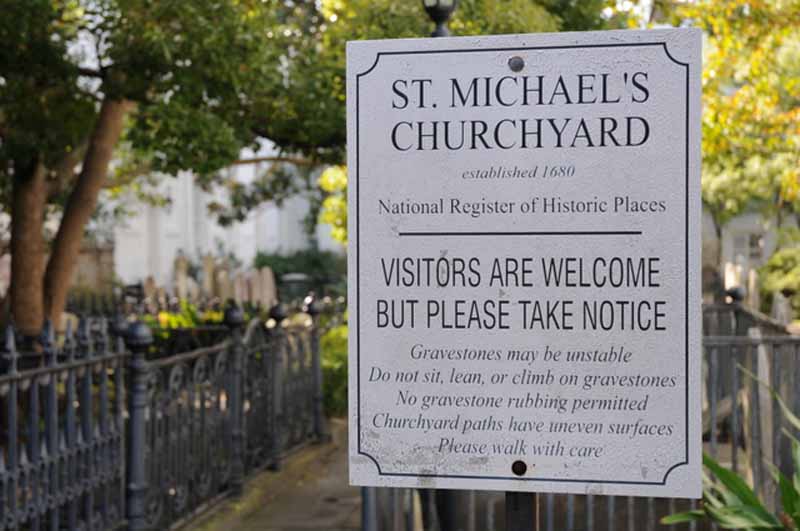
Ms. Miller credits her love for all things graveyard to "a group of morticians who stopped [her] at St. Michael’s Church and taught [her] about the grave sites." Since that tour of "over five graveyards in just two hours," she has delved into the stories of Charleston's past residents.

The greeting sign in front of St. Micheal's, the site that started it all.


She is a part of the highly acclaimed Association of Gravestone Studies which has members from all walks of life including historians, genealogists, stone cutters, and many more professions that tend to deal with the other side of life. This group often "believes graves are important to everyone" and they aim to preserve and document many of the sites around the country which hold great historical value.

Among her numerous achievements throughout her life including graduating from Duke University, becoming a social studies teacher, and established author on several articles, she has published a collection of pamphlets on the eleven 17th and 18th Century graveyards around downtown Charleston. They include anecdotes and photographs of the beautiful grounds in a portable format.

Ms. Miller and Professor Harwood exchanging books at the end of her lecture.


Throughout her visit to The College, she opened our eyes to many facts dealing with the historical statistics of Charleston’s beloved graveyards. Our city houses two 17th Century sites with the other nine being from the 18th century. Among these eleven grounds, Charleston is said to have “best collection of 18th century tombstones in the United States.” Although this fact is comical due to the fact that the Lowcountry is lacking heavily in the main component of tombstones; we have no stone! She cites the success of Lowcountry stone cutters immaculate work being so because they ordered the finest stone from northern areas and hand carved them once they reached South Carolina.

During her lecture, she also was able to tell stories of a few of her favorite grave sites that can be found in her publications about them. She pointed out St. Mary’s Roman Catholic, Circular Congregational Church, Unitarian Church, and St. Micheal’s as some of her favorites from around the city.

The story I loved most came from the Unitarian Church where the “most widely read woman at the turn of the Civil War” is buried. Carolina Gilman is inside it's graveyard but is often unspoken of because she and her husband owned slaves during their time and the Unitarian Church does not condone slavery so they more or less “swept them under” and erased them from their church.

Circular Conventional Church and its graveyard. Looking forward to visiting this one most.


In all, Ms. Miller’s visit was extremely informational yet interesting as she shared her love for all things grave to our class. We thank her very much for taking the time to teach us about one of the most historical places in our great city. Stay tuned for future posts where I explore some sites talked about in this post and others around the city!

“The wealthiest place on earth is the cemetery. There lies buried the greatest treasure of untapped potential.”
                        -Myles Munroe  

Photo Citations:
St. Micheal's Churchyard.  Hunt, Chris. 2009. Photo. U.S. Web Archives. <http://www.usgwarchives.net/sc/charleston/photos/tombstones/stmichaels/stmichae123nph.jpg> 

Ms. Miller and Professor Harwood. Personal Archives. 

Circular Church Graveyard: Friel, Thomas. 15 April 2016. Photo. Flickr. <https://c2.staticflickr.com/2/1602/26520156556_de82252906_b.jpg>


Friday, September 2, 2016

A Look Into My Life

Hi y'all! For anyone who does not know, my name is Montana. I was born in Summerville, South Carolina, where most of my family still lives, but relocated to Bessemer City, North Carolina when I was very young so my dad could follow work.

I have always considered South Carolina as my home and could not be happier to attend College of Charleston. I plan to study Business Administration with a concentration in entrepreneurship, and if time allows a minor in sociology.

Personal picture of how I revealed my college of choice.


I went to an unconventional high school called Gaston Early College; this school offers a college education along with normal high school courses. At GECHS I was part of our BETA Club chapter as President and Secretary in different years, I was Business Manager for our Yearbook staff where I made business ads and had to be in embarrassing promotional videos, I was also a part of the Student Ambassadors which helped bring upcoming freshman into the school.

My school was a big part of my life for five years and I miss it so very much along with the friends I left behind in North Carolina.


In North Carolina, I worked as a bakery assistant for the wonderful Cake Me Away Bakery where I did everything under the sun. I became assistant cupcake baker, head customer service, and head bar and cookie maker in the company. As stressful as all of it sounds, I would not give up the experience for anything. The lessons I have learned at the bakery have shaped my adult life to make me a harder worker, determined to see my successes, and more patient with people. I also cook a variety of savory foods which benefited the restaurant the company owns as well.

A picture of an event the bakery has done that I delivered and set up.


I want to own a dessert based food truck with my best friend. We both worked at the bakery and study business administration; our partnership was destined. I look forward to making so many new friends here at The College, including my new roommate from Japan!

There is so much more about me that just would not fit into this blog post; if I have left anything out please ask me in person! I love to meet new people!