On a wonderfully chilly, Charleston day, Hunter and I walked around to some of the historic gravesites around town. We visited three, two of which we had already visited with class. The Bethel UMC on Pitt, St. Luke and St. Paul Cathedral, and Second Presbyterian.
The Victorian gravesites around campus are beautiful and a great place to explore on a Saturday when you get the time.
Showing posts with label graveyard. Show all posts
Showing posts with label graveyard. Show all posts
Monday, December 5, 2016

Monday, November 28, 2016
The Sad Life of Dr. John Somers Buist
Dr. John Somers Buist was not only a doctor but a father to several children and a loving husband to his wife. He often dealt with childhood death as is ran rampant during the 19th century. He actually experienced childhood death first hand with the deaths of two his five children. This tragedy did not hinder his success as a physician but a prominent Charlestonian.
Margaret Sinclair Buist, John's wife, had five children; three of which lived good, long lives after the tragic deaths of their siblings. Daisy was the first to perish in 1877 when she was just one year old. She died from convulsions a common side effect of epilepsy. Even though she was the fifth child, she was the first one to pass away from the diseases of the 19th century which was a stroke of luck for the Buist household.
Their second child to pass away was their first born; the namesake of Dr. Buist. They called this boy Somers ad he lived until the age of seven when he died from diphtheria and the common whooping cough; I can personally attest to the whooping couch being terrible I had it when I was a little girl.
Both the children are buried together right beside the site for Dr. Buist. they have a small epitaph reading "He was weary and fell asleep, with his little sister, together they sing the song of the redeemed," according to Professor Harwood's book, In the Arms of Angels.
Even though Dr. Buist suffered great loss, he still had a successful working career. He was not only a father but a graduate of both the College of Charleston and the Medical University of South Carolina, a Civil War confederate surgeon, a doctor at the Roper Hospital in Downtown Charleston, the president of the Medical Society of South Carolina, and a board member at the Charleston Orphanage which just so happens to be on campus where the Berry Hall building is.
His grave site is a box tomb with a very plain outside especially for a man of his standing in downtown Charleston. It only has his name on the side and a small symbol in the front. He is buried in a plot along with a marker for the two children that passed away. Nothing is all that wonderful about his grave site nor his children's both are very plain and not magnificent.
I chose to do Dr. John Somers Buist in order to further learn about the name my building bears. I wanted to know why my building and many other things around the city of Charleston are marked with the Buist name. The Busit Academy on Calhoun Street bears the family name as well. It is unclear why the school is named after the family. I'd love to be able to talk to historians about why this school bears such a historic name and the other great things the Buist family did during their time.
 |
| A picture of Dr. Buist found on findagrave.com |
Margaret Sinclair Buist, John's wife, had five children; three of which lived good, long lives after the tragic deaths of their siblings. Daisy was the first to perish in 1877 when she was just one year old. She died from convulsions a common side effect of epilepsy. Even though she was the fifth child, she was the first one to pass away from the diseases of the 19th century which was a stroke of luck for the Buist household.
Their second child to pass away was their first born; the namesake of Dr. Buist. They called this boy Somers ad he lived until the age of seven when he died from diphtheria and the common whooping cough; I can personally attest to the whooping couch being terrible I had it when I was a little girl.
Both the children are buried together right beside the site for Dr. Buist. they have a small epitaph reading "He was weary and fell asleep, with his little sister, together they sing the song of the redeemed," according to Professor Harwood's book, In the Arms of Angels.
Even though Dr. Buist suffered great loss, he still had a successful working career. He was not only a father but a graduate of both the College of Charleston and the Medical University of South Carolina, a Civil War confederate surgeon, a doctor at the Roper Hospital in Downtown Charleston, the president of the Medical Society of South Carolina, and a board member at the Charleston Orphanage which just so happens to be on campus where the Berry Hall building is.
His grave site is a box tomb with a very plain outside especially for a man of his standing in downtown Charleston. It only has his name on the side and a small symbol in the front. He is buried in a plot along with a marker for the two children that passed away. Nothing is all that wonderful about his grave site nor his children's both are very plain and not magnificent.
 |
| My picture of the Buist gravesite. |
I chose to do Dr. John Somers Buist in order to further learn about the name my building bears. I wanted to know why my building and many other things around the city of Charleston are marked with the Buist name. The Busit Academy on Calhoun Street bears the family name as well. It is unclear why the school is named after the family. I'd love to be able to talk to historians about why this school bears such a historic name and the other great things the Buist family did during their time.
Sunday, September 25, 2016
Purple Skies and Dead Guys: Exploring Two of Downtown Charleston's Historical Graveyards
Chasing storms and knowledge, the Beyond the Grave FYE class at College of Charleston was able to visit two of the closest graveyards near campus.
The serene, historical sections of Cathedral Church of St. Luke and St. Paul and the St. Patrick Catholic Church provided the first experiences of our small class of twenty. Walking through these old graveyards we saw several different types of gravestones with many different symbols. I want to show you some of my favorites along with the interesting epitaphs on these stones.
First we visited the Cathedral Church of St. Luke and St. John, on beautiful Coming Street (I'm a little biased because I live on Coming), which boasted a grand white steeple and wrought iron fencing around the property. This graveyard featured a collection of different styles along with a variation of different years people were placed into the yards there; the most recent I found was 2013.
The site pictured on the left, reads "Thos. George Simons and Catherine Hume, His wife Catherine died Aged 84, 6 months, 26 days." On the other sides of the square, an epitaph to George was also written. This particular urn stood out to me because it was in a section that had flood lighting. I am very curious to know why lights were placed around this one little section of St. Luke's.
This mausoleum is one of the most "decorated" of the graveyard. It has two torches and a phrase in Latin across the top. The phrase "qui christo vivit perire nescit" I found has conflicting meanings. On Professor Harwood's blog it says the inscription means "it is hard to kill a rose in a churchyard" but in Google Translate the phrase translates to "He knows that Christ lives lost" which I believe makes more sense because Christo is Latin for Christ. This monument also has inverted torches with flames that symbolize eternity and death. (As of October 19,2016, Professor Harwood's blog now has an updated explanation of this phrase.)

This column was hidden in a back section of the graveyard and has the cut off top to symbolize a life stopped too soon or "cut off." It also has a wreath on the top that was adopted by Christians and Greeks as victory and redemption. This one looks like an laurel wreath which is usually used for people who have a high distinction in the literature and arts.
The picture below is of Alice Flacc Simons who was born April 19, 1849 and died on January 13, 1891. Her grave was extremely beautiful to me and offered a sense of serenity when I looked at it. She is in what is known as a tomb grave; hers is just lower than most typical tomb graves.
The serene, historical sections of Cathedral Church of St. Luke and St. Paul and the St. Patrick Catholic Church provided the first experiences of our small class of twenty. Walking through these old graveyards we saw several different types of gravestones with many different symbols. I want to show you some of my favorites along with the interesting epitaphs on these stones.
 |
A picture of the storm we ventured into. This photo does not
do the violet skies justice.
|
 |
The sign on the front of St. Luke's
They also have a coveted Carolopolis
award.
|
First we visited the Cathedral Church of St. Luke and St. John, on beautiful Coming Street (I'm a little biased because I live on Coming), which boasted a grand white steeple and wrought iron fencing around the property. This graveyard featured a collection of different styles along with a variation of different years people were placed into the yards there; the most recent I found was 2013.
 |
Found in the graveyard of St. Luke,
this is an example of a Pedestal tomb with an urn atop it.
|
 |
This mausoleum is fenced in with gates and has no
indication of what family is inside.
|
This mausoleum is one of the most "decorated" of the graveyard. It has two torches and a phrase in Latin across the top. The phrase "qui christo vivit perire nescit" I found has conflicting meanings. On Professor Harwood's blog it says the inscription means "it is hard to kill a rose in a churchyard" but in Google Translate the phrase translates to "He knows that Christ lives lost" which I believe makes more sense because Christo is Latin for Christ. This monument also has inverted torches with flames that symbolize eternity and death. (As of October 19,2016, Professor Harwood's blog now has an updated explanation of this phrase.)

This column was hidden in a back section of the graveyard and has the cut off top to symbolize a life stopped too soon or "cut off." It also has a wreath on the top that was adopted by Christians and Greeks as victory and redemption. This one looks like an laurel wreath which is usually used for people who have a high distinction in the literature and arts.
The picture below is of Alice Flacc Simons who was born April 19, 1849 and died on January 13, 1891. Her grave was extremely beautiful to me and offered a sense of serenity when I looked at it. She is in what is known as a tomb grave; hers is just lower than most typical tomb graves.
\

Our last stop for the night was the St. Patrick's Catholic Church graveyard which offers very little variety in headstones with many of them containing crosses.

During this trip one specific cross stuck out more than any other the others, it was carved to look like a tree in my perception and it had ivy leaves carved around in a winding pattern like it had just overgrown onto the cross. It is also a representation of the die and socket style of gravestone. The ivy winding around the cross is a symbol for many things like memory, immortality, and eternal life among others.

There was another cross with what looks to be grapes surrounding it on vines on a headstone. The grapes are used to symbolize Christ. It also appears to have some sort of ivy snaking around it as well.

The last symbol is probably one of my favorites as Weeping Willows remind me of my childhood down here in South Carolina. The weeping willow is said to stand for nature's lament and mourning. This stone is also very peculiar to me as the top of it resembles the Devil's horns.

As this post draws to a close, I encourage you to visit both of these beautiful graveyards and walk among the stories hidden in stone. Thank you for following my stormy adventure around Charleston!
|
Sunday, September 18, 2016
Exciting Historian Shares Knowledge at College of Charleston
You may be "crazy" about a favorite band, activity, or hobby; well, Ms. Ruth Miller has the dead running trough her head. She came to share her extensive knowledge thanks to Professor Harwood.
Ms. Ruth Miller, established Charleston historian and expert for over 30 years, shared her immense knowledge with the FYE Beyond the Grave. While Ms. Miller is revered as a historian for all of Charleston, her favorite places to speak about are where Charleston's deceased lie.
Ms. Miller credits her love for all things graveyard to "a group of morticians who stopped [her] at St. Michael’s Church and taught [her] about the grave sites." Since that tour of "over five graveyards in just two hours," she has delved into the stories of Charleston's past residents.
She is a part of the highly acclaimed Association of Gravestone Studies which has members from all walks of life including historians, genealogists, stone cutters, and many more professions that tend to deal with the other side of life. This group often "believes graves are important to everyone" and they aim to preserve and document many of the sites around the country which hold great historical value.
Among her numerous achievements throughout her life including graduating from Duke University, becoming a social studies teacher, and established author on several articles, she has published a collection of pamphlets on the eleven 17th and 18th Century graveyards around downtown Charleston. They include anecdotes and photographs of the beautiful grounds in a portable format.
Throughout her visit to The College, she opened our eyes to many facts dealing with the historical statistics of Charleston’s beloved graveyards. Our city houses two 17th Century sites with the other nine being from the 18th century. Among these eleven grounds, Charleston is said to have “best collection of 18th century tombstones in the United States.” Although this fact is comical due to the fact that the Lowcountry is lacking heavily in the main component of tombstones; we have no stone! She cites the success of Lowcountry stone cutters immaculate work being so because they ordered the finest stone from northern areas and hand carved them once they reached South Carolina.
During her lecture, she also was able to tell stories of a few of her favorite grave sites that can be found in her publications about them. She pointed out St. Mary’s Roman Catholic, Circular Congregational Church, Unitarian Church, and St. Micheal’s as some of her favorites from around the city.
The story I loved most came from the Unitarian Church where the “most widely read woman at the turn of the Civil War” is buried. Carolina Gilman is inside it's graveyard but is often unspoken of because she and her husband owned slaves during their time and the Unitarian Church does not condone slavery so they more or less “swept them under” and erased them from their church.
In all, Ms. Miller’s visit was extremely informational yet interesting as she shared her love for all things grave to our class. We thank her very much for taking the time to teach us about one of the most historical places in our great city. Stay tuned for future posts where I explore some sites talked about in this post and others around the city!
“The wealthiest place on earth is the cemetery. There lies buried the greatest treasure of untapped potential.”
-Myles Munroe
Photo Citations:
St. Micheal's Churchyard. Hunt, Chris. 2009. Photo. U.S. Web Archives. <http://www.usgwarchives.net/sc/charleston/photos/tombstones/stmichaels/stmichae123nph.jpg>
Ms. Miller and Professor Harwood. Personal Archives.
Circular Church Graveyard: Friel, Thomas. 15 April 2016. Photo. Flickr. <https://c2.staticflickr.com/2/1602/26520156556_de82252906_b.jpg>
Ms. Ruth Miller, established Charleston historian and expert for over 30 years, shared her immense knowledge with the FYE Beyond the Grave. While Ms. Miller is revered as a historian for all of Charleston, her favorite places to speak about are where Charleston's deceased lie.
Ms. Miller credits her love for all things graveyard to "a group of morticians who stopped [her] at St. Michael’s Church and taught [her] about the grave sites." Since that tour of "over five graveyards in just two hours," she has delved into the stories of Charleston's past residents.
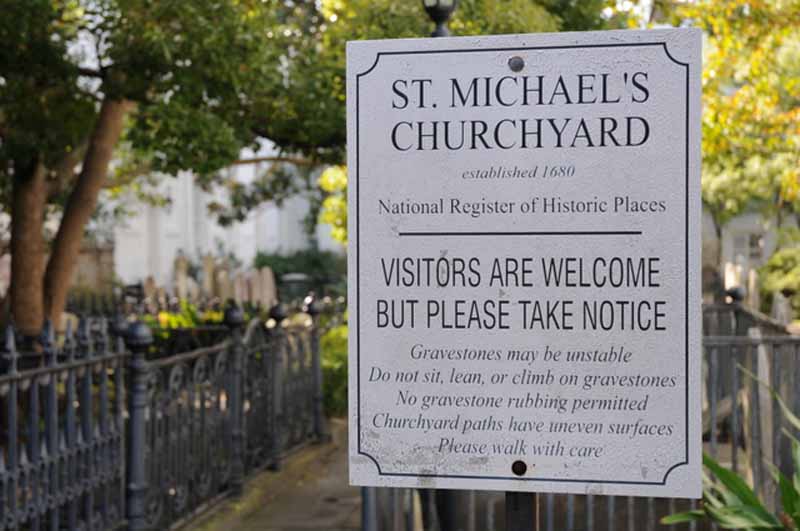 |
| The greeting sign in front of St. Micheal's, the site that started it all. |
She is a part of the highly acclaimed Association of Gravestone Studies which has members from all walks of life including historians, genealogists, stone cutters, and many more professions that tend to deal with the other side of life. This group often "believes graves are important to everyone" and they aim to preserve and document many of the sites around the country which hold great historical value.
Among her numerous achievements throughout her life including graduating from Duke University, becoming a social studies teacher, and established author on several articles, she has published a collection of pamphlets on the eleven 17th and 18th Century graveyards around downtown Charleston. They include anecdotes and photographs of the beautiful grounds in a portable format.
 | ||
| Ms. Miller and Professor Harwood exchanging books at the end of her lecture. |
Throughout her visit to The College, she opened our eyes to many facts dealing with the historical statistics of Charleston’s beloved graveyards. Our city houses two 17th Century sites with the other nine being from the 18th century. Among these eleven grounds, Charleston is said to have “best collection of 18th century tombstones in the United States.” Although this fact is comical due to the fact that the Lowcountry is lacking heavily in the main component of tombstones; we have no stone! She cites the success of Lowcountry stone cutters immaculate work being so because they ordered the finest stone from northern areas and hand carved them once they reached South Carolina.
During her lecture, she also was able to tell stories of a few of her favorite grave sites that can be found in her publications about them. She pointed out St. Mary’s Roman Catholic, Circular Congregational Church, Unitarian Church, and St. Micheal’s as some of her favorites from around the city.
The story I loved most came from the Unitarian Church where the “most widely read woman at the turn of the Civil War” is buried. Carolina Gilman is inside it's graveyard but is often unspoken of because she and her husband owned slaves during their time and the Unitarian Church does not condone slavery so they more or less “swept them under” and erased them from their church.
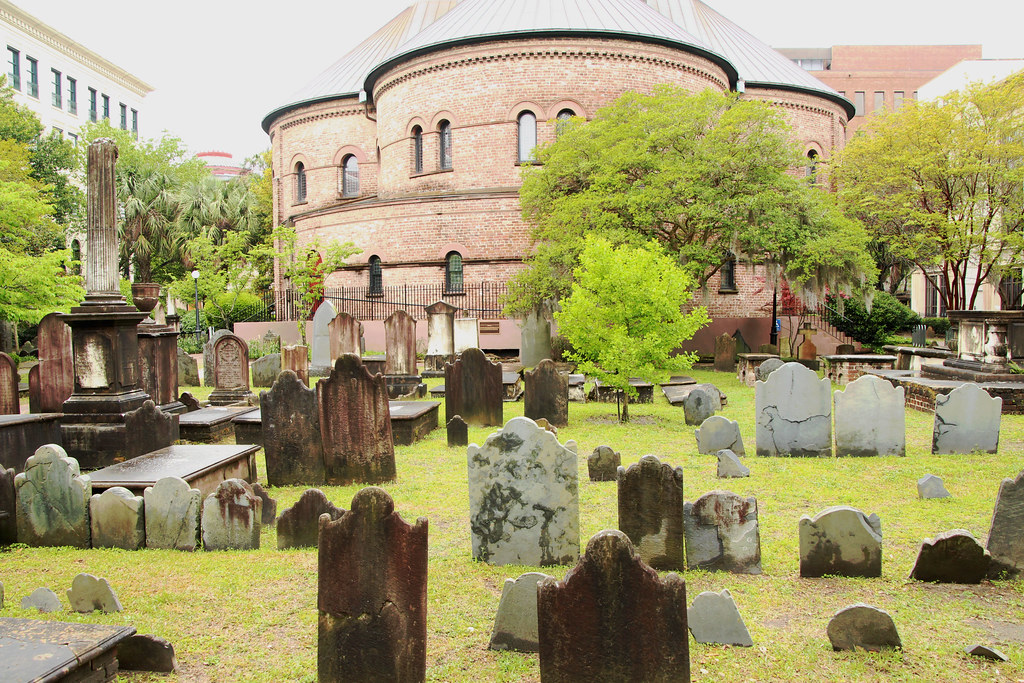 |
| Circular Conventional Church and its graveyard. Looking forward to visiting this one most. |
In all, Ms. Miller’s visit was extremely informational yet interesting as she shared her love for all things grave to our class. We thank her very much for taking the time to teach us about one of the most historical places in our great city. Stay tuned for future posts where I explore some sites talked about in this post and others around the city!
“The wealthiest place on earth is the cemetery. There lies buried the greatest treasure of untapped potential.”
-Myles Munroe
Photo Citations:
St. Micheal's Churchyard. Hunt, Chris. 2009. Photo. U.S. Web Archives. <http://www.usgwarchives.net/sc/charleston/photos/tombstones/stmichaels/stmichae123nph.jpg>
Ms. Miller and Professor Harwood. Personal Archives.
Circular Church Graveyard: Friel, Thomas. 15 April 2016. Photo. Flickr. <https://c2.staticflickr.com/2/1602/26520156556_de82252906_b.jpg>
Subscribe to:
Posts (Atom)